Archive: Dev Blog

3rd September – Chucklefish Blog

Hey guys!

In lieu of the daily post, yesterday Tiy took to our newly-launched Chucklefish Blog to post about what’s left to do before Starbound reaches version 1.0. Fair warning, though– the post and charts within contain spoilers aplenty.

You can check out the post here.

RE: The Chucklefish Blog – we’ll be posting Chucklefish-related updates there, and updates from developers of games we’re publishing. So keep an eye out! The site’s still not quite finished, either, and we’ll be filling it out a bit more in the coming days.

Regular daily progress posts will resume today!

September 2nd – New Mission Prep

Hey y’all!

I spent my day helping George by setting up a dungeon file and key for the mission he’s about to start working on. He had already knocked up a detailed plan of the mission’s structure and layout, so he spent most of today roughing it out visually in-game while I worked on getting a functional setup together. George seems keen to tell a story with the environment, so he’s been creating a bunch of cool new objects as he’s progressed.

It looks for the most part like he has everything necessary to get started turning it into a functional location, so most likely he’ll be spending the next week focusing on this mission. I’ll probably get called in from time to time to help him with the finer points of the dungeon system, but I’m really looking forward to seeing how he does with it, since his mockups are generally very good and having someone else to work on this stuff with me will be most welcome.

Sorry I don’t have anything fancy to show off, it’s just been that kind of work lately and we’d like to keep at least a few surprises, if possible.

Good night!

September 1st – WIPs

Not much exciting to post about today. Kyren’s been working on nitty gritty technical stuff, addressing some threading issues we’re running into with C++11 pointers. Armagon and the artists are continuing work on missions that I’m not allowed to post about yet.

I’m still playing with the terrain generation, seeing what its capabilities and limitations are. Here’s a screenshot of some WIP desert canyons (click for big):
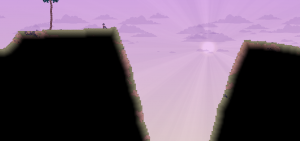
canyonswipThe terrain generator works by combining multiple layers of Perlin noise. In this shot, I’m using one source to define the primary surface terrain (low dunes), another source to define the rough bottom of the canyons, and a third to mix between them, with bias toward the primary source to make canyons less frequent. There are several problems with the current configuration, however. The most obvious problems are the sharp corners at the canyon edge where the mix shifts from 100% primary surface and rapidly begins switching to the lower canyon terrain. These can be addressed with some smoothing in the mixer (which needs engine changes to implement). Another issue without an obvious solution is what to do with the background. Because of the dimensionality and limited number of layers, it’s difficult to visually distinguish an open valley from a long, narrow canyon from a deep hole. I’ll have to experiment further to find a satisfactory solution.